Poem
A Space Reserved for Her
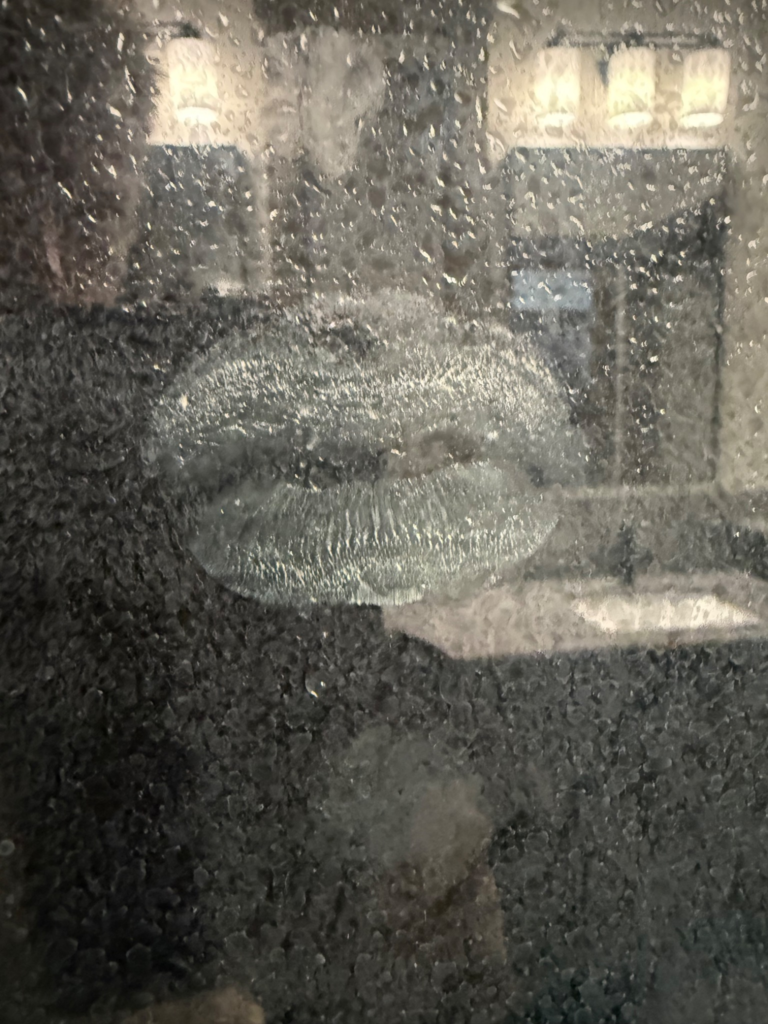
An impression left with the lips
Not on glass, but another place
A quiet place only she can embrace
I touch this place
Even though it’s not a face
To remind me just of her
If the lips be wiped away
There will always be a day
I hope to see that space replaced by her
Until that day
The glass will stay
But that space is always reserved for her
About this Poem
We now venture trepidatiously into the waters of cliché, albeit love. I can guarantee the evasion of the familiar – drowning in one’s suffering. I can’t dismiss my drift towards the undertow of profession.
We have all met them, those who leave an impression (those lips). One withdraws, not for an apparent reason but for one unknown to them (that glass). Time passes, but moments arise that remind us of the space they occupied, and a lingering question: “What would have happened if I stayed?” And if such a time arises where that “if” may be answered: What if that glass remained, or another took its place? Grew thicker with time. Could we wipe the lips away, turn from an impression and towards their reception? Here is my hypothetical, and my reality.
So what is this glass, Dear Reader, I ask. Perhaps we may journey past this together:
Charles: “I find myself thinking of the phrase ‘it wasn’t the right time.’ The things we tell ourselves to stay back, not to try, not to invest, so as not to be vulnerable for fear of rejection and harm. The subtle escapes and moves towards separation rather than security.”
Dear Reader: “Well then, considering such things, is not this obstacle of your own creation?”
Charles: “I believe so; however, how does one overcome this part of oneself? This self that fears to be hurt.”
Dear Reader: “Perhaps in the recognition of self, in recognition you’ve been hurt.”
Charles: “To be seen, for who we are?”
Dear Reader: “Yes (and a silent moment passes). I’m reminded of a man I once knew. He was hurt, but he didn’t wish to be seen as such. He tries nonetheless to appear what he is not, but the hurt bleeds through. For example, Charles, have you ever written with a pen, finished your work, and found that the ink had bled through to the page beneath it?”
Charles: “Yes.”
Dear Reader: “That hurt, like the ink bleeds through in many ways.”
Charles: “I see. I believe this is true for many.”
Dear Reader: “Yes, that hurt can be many things.”
Charles: “Nonetheless, should we not all try?”
Dear Reader: “A good question and an uncertain space. Let us consider the ink once again. What do we do with the pages the ink has bled upon?”
Charles: “We remove them, discard them.”
Dear Reader: “Yes, but we also learn not to write again with pages behind the one we are writing upon. We separate these future pages intended for use, keep them distant and apart for fear of future harm.”
Charles: “I believe these pages to be the people that come into our lives.”
Dear Reader: “Yes, as a result of our trying.”
Charles: “A gloomy end, I do not want. I mean no harm.”
Dear Reader: “Of course not, but to abstain also leaves us with an unjust end. For we are not the first offenders. Perchance, we were once the pages bled upon.”
Charles: “This is true.”
“Dear Reader, how do we stop the ink from bleeding through?”
Dear Reader: “Simple, we try something different than what we always do.”
A private Euthyphro: do I refrain because I love, or do I name my refraining “love” because I fear to stain the next page?
The nature of this glass is not abstract; it is lived by many. Those who have been discarded or neglected, those shaped by trauma and uncertainty, fear being discarded, just like the stained pages (The Contrasting Colors of Society). So they push people away, often the ones they love most. It shows up as many things, for some: avoidance (not sharing your struggles), hyper-independence (fear of burdening another), and reluctance to commit (“it wasn’t the right time”). Underneath is a simple truth: they want love and security.
Here, distance is a clumsy form of devotion. If the ink keeps seeping, the answer is not to stop writing, but to try something different. Different means changing the tools and the pace: thicker paper (boundaries), a lighter hand (pacing and patience), a blotter at the ready (repair when we misstep), and time to dry (letting trust set before we stack new pages on top).
Now, Dear Reader, we have averted the typical clichés of love. But as I said, I must profess not just for me but for her. That I do love her, will always be there for her, and provide her with the security she deserves. If she ever has a doubt, may she return to this and be reminded that if that glass should arise again, it is not a shrine to avoidance but a reservation for return – for that space I will always reserve for her.
Charles Randolph
Members Visual
Members Video Interpretations
If this poem moved you, consider becoming a member to support ToSpeakOnline.com — where we’re committed to delivering thoughtful, good information to the public. Your membership helps fund our contributors and sustain a space where meaningful voices can thrive.
Follow Us On Your Favorite Platform!
Best Seller
 The Body Keeps the Score: Brain, Mind, and Body in the Healing of Trauma |
Our Pick
 The New Rules of Attachment: How to Heal Your Relationships, Reparent Your Inner Child, and Secure Your Life Vision |
Go For It!
 Stop Self-Sabotage: Six Steps to Unlock Your True Motivation, Harness Your Willpower, and Get Out of Your Own Way |
|---|